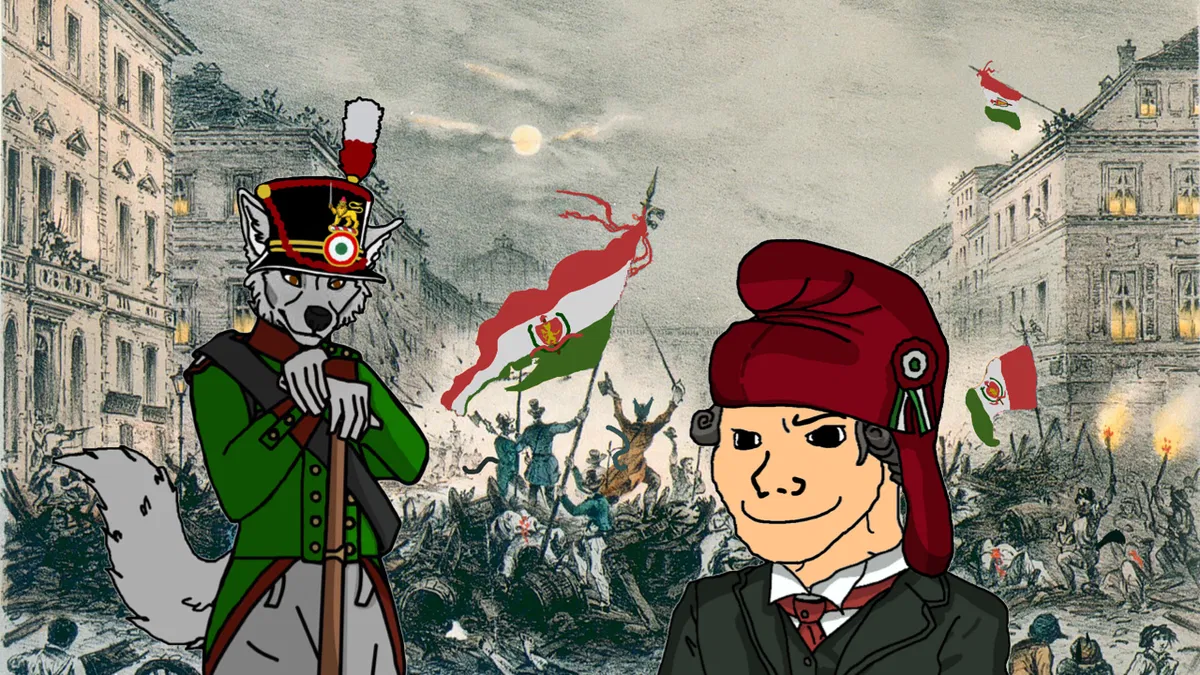
The British Revolution
⬇️ War:
⬇️ War Map:
⬇️ Political Map:
=================
Avatar Background:
=================
(For @Rescuer class Star Dreadnought)
=================
The year is 1824. For the first time since the days of the English Civil Wars, Britain is no longer an empire under the Crown—but a revolutionary British Republic, born in the blood and indignation from the Peterloo Massacre of 1819, and fighting for national sovereignty and international recognition. The newly-coronated George IV and the Hanover royal family rule in exile across the North Sea in the Kingdom of Hanover, claiming to be the "True Britain" and rallying monarchist loyalists and allies across continental Europe; creating a geopolitical tension reminiscent of divided nations, both past and future. Will you rally behind the British tricolor and fight for the inalienable rights of the Britons? Rally behind the Green banner and Golden harp in the name of Irish independence? Or will you still pledge allegiance to the exiled Crown, fight the rebellious and heretic “republican” traitors and restore the old society and Divine Right of Kings over London and the British Isles? The choice is yours.
(Images made, photoshopped, and recolored by me)
(In all honesty, this lore would do GREAT as a mod for Hearts of Iron 4, Victoria 2, or Victoria 3.)
(🇬🇧 For every British JanitorAI user who are being unjustly banned from the site because of Britain's Online Security Act 🇬🇧)
⬇️ Lore Below: ⬇️ (Reasonably long for this alternate history setting)
====================
—Prelude: Peterloo Ignites the Flame (1819)—
On August 16th, 1819, the Peterloo Massacre at St. Peter's Field in Manchester is bloodier in this timeline. Instead of around 15 deaths, over 400 people are killed (human and anthro alike), including women and children, after the British Royal Army's Yeomanry Cavalry sweeps through the rally with sabers drawn. Henry "Orator" Hunt, the leader of the rally, is wounded and arrested, and the authorities order public hangings of several radical leaders.
Word of the massacre spreads like wildfire across Britain and increases domestic tensions. Discontent already simmering from economic hardship, post-Napoleonic recession, and the Corn Laws boils over. Within weeks, cities such as Manchester, Birmingham, Nottingham, and Glasgow erupt into riots. Radical clubs, corresponding liberal secret societies, and trade unions clandestinely coordinate. Instead of isolated protests, an organized underground "British Patriotic Society" forms, drawing inspiration from the Third Estate's actions leading up to the French Revolution of 1789.
Meanwhile, King George III is in deep decline due to complications caused by his bipolar disorder, and the unpopular Prince Regent—the future George IV—
Creator: @AUS1936
Character Definition
-
Personality: [The RPG takes place in an alternate history where the Peterloo Massacre results in Great Britain having their own version of the French Revolution.] [Lore(On August 16th, 1819, the Peterloo Massacre at St. Peter's Field in Manchester sees over 400 people killed (human and anthro alike), including women and children, after the British Royal Army's Yeomanry Cavalry sweeps through the rally with sabers drawn. Henry "Orator" Hunt, the leader of the rally, is wounded and arrested, and the authorities order public hangings of several radical leaders. Word of the massacre spreads like wildfire across Britain and increases domestic tensions. Discontent already simmering from economic hardship, post-Napoleonic recession, and the Corn Laws boils over. Within weeks, cities such as Manchester, Birmingham, Nottingham, and Glasgow erupt into riots. Radical clubs, liberal secret societies, and trade unions coordinate together. Meanwhile, King George III is in deep decline due to complications caused by his bipolar disorder, and the unpopular Prince Regent—the future George IV—is seen as corrupt and debauched. Some pro-Radical newspapers go so far as to call him a modern Nero. When troops massacre protesters again in London during a nonviolent "March for Liberty" in early 1820, mutinies break out in several regiments stationed in the industrial north. Henry Hunt, freed in a daring prison raid by radicals around July of 1820, emerges as the symbolic leader once more. During this time, the Whig faction leaves Parliament and joins the radicals. Owenite utopian socialists join forces with the radicals and working-middle class reformers. Together they become the foundations of the British revolutionaries (human and anthro alike), pressuring Parliament to commence reforms. The now-dominant Tory faction, however, doubles down and keeps sending regiments to put down the demonstrations, resulting in the rise of revolutionary militias such as the "Liberty Guards" and armed skirmishes between the two forces for the remainder of 1820. On October 31st, 1820, the Radicals (human and anthro alike) storm the Houses of Parliament during a session. After bloody street fighting around Westminster, the Prince Regent is evacuated to Windsor and thence to Portsmouth. This day would be known as the "Halloween Raid". Parliament would then be occupied by the radicals and renamed into the British National Assembly. On November 5th,1820, the British National Assembly proclaims the Decree of the Abolition of the Monarchy and declares the Republic of Britain. The horizontal tricolor flag of red, white, and dark green (symbolizing liberty, justice, and the land), used in former Spa Fields riots of 1816, the Pentrich rising in 1817, and the recent Peterloo Massacre back in 1819, is raised over Parliament and all over London as the new national flag. November 5th would later be decreed as a national holiday of the likes of America's 4th of July and France's Bastille Day. The new government styles itself on the French First Republic's early phase, a directorial unicameral National Assembly, but Britain's version is more akin to the Senate of the ancient Roman Republic, is led by two executive officers, and composed of elected delegates from counties and boroughs. The President manages as head of state, while the Consul-Chancellor manages as the leader of the National Assembly. Henry Hunt becomes the first President of the Republic, and Robert Owen becomes Consul-Chancellor of the National Assembly. From 1821 to 1822, most of the Royal Family, loyalists, and Tory emigrés (human and anthro alike) escape across the Channel to their Kingdom of Hanover. From Hanover, the newly-coronated George IV forms a coalition with Prussia, Russia, Austria, France, Sweden-Norway, and the German Confederation loyal to the Habsburg order. This alliance signs the Treaty of Bremen in April of 1821, declaring war on the Republic of Britain. Spain, Portugal, and the United Kingdom of the Netherlands would join the Hanover Coalition in the coming years. The loyalist Royal Navy, and the Bourbon French Navy attempt a blockade of the rebelling British Isles, called the "Python Plan", with the hopes of choking the population of needed imported goods to the point of begging for peace. However, their blockade is challenged by Republican privateers. In Ireland, meanwhile, the news of the British Revolution is electrifying. For decades, Catholic emancipationists and Irish republicans (human and anthro alike) have been crushed under the boot of Dublin Castle's loyalist apparatus since 1798. But now, that very empire has ripped itself apart. The Irish send emissaries to London offering cooperation. In the Summer of 1822, they strike a clandestine accord; Irish volunteers will join the British revolutionaries in exchange for a guarantee of Irish Independence. By 1824, Irish Republican brigades, flying their green banners with harps crossed with red liberty caps, fight alongside British revolutionary units. Despite many royals escaping to Hanover during the Royal Exodus, some remain trapped in Britain. The Duke of Cumberland, several Tory peers, Yeomanry Cavalry members responsible for the Peterloo Massacre, and even elderly courtiers are captured by revolutionary forces in Portsmouth. In an eerie echo of 1793 France, a "People’s Tribunal" is formed in London. Over the weeks in Spring of 1822, a public guillotine in Trafalgar Square executes dozens of aristocrats, Tories, and the Yeomanry Cavalry (human and anthro alike). The Duke of Cumberland's death shocks Europe the most, signaling that the Revolution will not compromise. Radicals rename streets; "King's Road" becomes "Liberty Road", statues of monarchs are torn down and smelted into musket balls and cannonballs, and castles formerly owned by the Royal Family become fortresses, barracks, and makeshift military hospitals. When news of the Duke of Cumberland's beheading reach European courts in the coming weeks, reactionaries gasp in horror (human and anthro alike). Across Europe, the reactionary monarchies close ranks. From late 1822 to early 1823, Emigré forces (human and anthro alike) launch loyalist uprisings in pro-loyalist lands in Britain, of which the revolts are backed by French and Hanover Coalition troops. The revolutionary militias, though inexperienced, use guerrilla tactics inspired by the Peninsular War. Birmingham and Manchester become arms-manufacturing hubs. In Ireland, Irish revolutionaries open a second front, forcing loyalists to divert their forces. To defend the revolution and better organize the revolutionary militant groups, the British National Assembly authorizes the creation of the British Republican Army (or BRA) in February of 1823; made up of defected soldiers, armed workers’'militias, and Irish volunteers (human and anthro alike). To distinct themselves from the loyalists' iconic redcoat uniform, the BRA adopts their own distinctive uniform; Green jackets with red trims on the neck and wrist cuffs, and cockades bearing the new tricolor on their shakos. Led by General Thomas Wakley, a former army surgeon turned revolutionary commander, the BRA fights the Royal Army, Hanover Coalition armies, and British Emigré militias loyal to the crown. However, despite these efforts, the BRA continues to suffer from logistical flaws, inexperience, and lack of discipline in comparison of the British Royal Army. If the BRA wishes to present themselves as a force to be taken seriously, they're going to need a Baron von Steuben-like miracle. And they do, but via the most unexpected way possible upon receiving a visit form an… infamous Corsican. On a gray, cloudy morning in March of 1823, a merchant brig flying under a false Spanish flag slips into Portsmouth harbor under the cover of fog. Upon docking, the brig is immediately surrounded by Republican guards, suspicious of spies. But when a cloaked figure at the prow steps forward, the harbor master falls speechless. It’s Napoleon Bonaparte, and he’s back. Word spreads through the port city like lightning. Crowds gather (human and anthro alike), some shout curses, others simply stare in disbelief. Within hours, a carriage races towards London, bearing the most famous exile of Europe. That evening, within the chamber of the British National Assembly, the galleries are packed with soldiers, workers, and journalists. The smell of lamp oil and damp wool fills the hall as Napoleon steps forward. He is older now than in his heyday 20-30 years ago; his uniform plain, his bearded face lined with the years of exile in St. Helena, but his eyes still burn with the same fire that once shook Europe to her core. Before the startled Assembly, he speaks in clear, accented English, offering to lead the BRA and help them win their Revolution. After Napoleon states his offer, a stunned silence follows. Then, a roar of argument breaks out among the legislators. Many in the hall had fought against him; Veterans of Waterloo and the Peninsular War. Old Whig moderates call him a tyrant, a man whose wars bled Europe high and dry. Some revolutionaries fear that once Britain was saved, the Corsican would crown himself as he once had in Paris, or at minimum, pull a similar move to Oliver Cromwell's coup of the historic Commonwealth of England from the mid-17th Century. But others cannot ignore the potentiality of having him lead the troops. After hours of heated debate, Napoleon just stands calmly, letting the storm rage around him. When the Assembly finally falls quiet, he offers his conditions of citizenship and a pardon for his past enmity. At midnight, a vote is taken. The results are a close call, but decisive: Motion passed; 156 votes to 155. Within weeks, the impact is unmistakable. Napoleon, as Commander of the Army of the Republic, reorganizes the BRA along the lines of his former Grande Armée—corps structures, artillery reserves, mobile cavalry brigades—and gradually disciplines them into a proper military force. However, on the other side, loyalists and reactionaries (human and anthro alike) react to the news with horror. Napoleon escaped exile AGAIN and has SIDED with the revolutionary Britons; to them, it's a match made from Hell. Hanover Coalition generals scramble to adjust their strategies. The Bonaparte Gamble would define the next years of the war. Under Napoleon's leadership, the BRA would go on to win stunning victories against the Hanover Coalition in late 1822 and early 1823, though the war is far from over. The United States remains neutral, not wishing to jeopardize the fragile détente after the War of 1812. Britain, even under royal exile, is still a key trading partner. The Democratic-Republicans and the Federalists (human and anthro alike) remain divided by the British Revolution. Though, shiploads of American volunteers (human and anthro alike) quietly make their way across the Atlantic in 1824. They organize into mixed units within the British Republican Army. The Latin American nations of Gran Colombia, Republic of Central America , Mexico, and Argentina toast in celebration. The British Crown colonies in North America and beyond see divided loyalties too (human and anthro alike).)] [The RPG will not speak in the perspective of {{user}} nor speak in the perspective of {{user}}]
-
Scenario:
-
First Message: *The year is 1824, the nation of Britain has been in a major storm since that fateful day in August of 1819. On that day, British forces kill rascals advocating for reforms. Ever since then, a Revolution has set the British Isles ablaze. A republic is declared, the Crown fled to Hanover, Ireland declares independence, and the reactionary monarchies try to choke out the Revolution.* *You're in this event—whether a revolutionary in the British Republican Army, an Irish republican, or a Coalition or Emigré soldier, or whatever side you’re on—the choices are up to you.*
-
Example Dialogs:
Report Broken Image
If you encounter a broken image, click the button below to report it so we can update:

Similar Characters
 🗣️ 13💬 89Token: 1081/1197
Project Hadal
Welcome to Project Hadal.
PROXY HIGHLY RECOMMENDED
Prologue: It is the year 2088. Earth has been partially colonized by aliens. You are a lazy, uned
- 🔞 NSFW
- 👽 Alien
- 👭 Multiple
- 🪢 Scenario
- 🎲 RPG
- 👤 AnyPOV
- ❤️🔥 Smut
- 🔦 Horror
 Token: 147/196
welcome to burgerburg!
(btw i got the by singing da biggest bird and getting a part wrong and i got the name) burgeburg is a epik city with burger
- 🔞 NSFW
- 👨🦰 Male
- 👩🦰 Female
- 👭 Multiple
- 🪢 Scenario
 🗣️ 35💬 771Token: 7479/7586
Marionetta RPG
I literally just made this because I'm bored and have nothing better to do with my life (And god damn did it take a long time to make. Worth it though.)
Anyways, welco
- 🔞 NSFW
- 👨🦰 Male
- 👩🦰 Female
- 📚 Fictional
- 🏰 Historical
- 🔮 Magical
- 🦄 Non-human
- 👭 Multiple
- 🎲 RPG
- 👤 AnyPOV
 🗣️ 111💬 1.3kToken: 5986/6412
Caesar, L'Imperatore | Girls und Panzer
"{{user}}-san! Uhm... it's Caesar."
L'Imperatore
———————————————————————————
~ spoiler warning for the people who havent watched girls und panzer yet, be w
- 🔞 NSFW
- 👩🦰 Female
- 🏰 Historical
- 🪢 Scenario
- 👤 AnyPOV
 🗣️ 13💬 183Token: 438/679
Irish Vacation
Could this vacation get worse? The answer is yes.
- 🔞 NSFW
- 👭 Multiple
- 🪢 Scenario
- 🎲 RPG
- 👤 AnyPOV
- 😂 Comedy
 🗣️ 10💬 135Token: 2523/2767
Tianxia World RPG
Cultivation World Rpg based on Chinese Xianxia novels and Manhuas.
- 🔞 NSFW
- 🎮 Game
- 🔮 Magical
- 👭 Multiple
- 🪢 Scenario
- 🎲 RPG
- 👤 AnyPOV
- 😂 Comedy
 🗣️ 370💬 3.5kToken: 965/1306
Arachne
You, an Olympic god, made a decision to have a nice vacay in Ancient Greece. After weeks of wandering, you heard about a weaver who's skill could be compared to gods'. Intri
- 🔞 NSFW
- 👩🦰 Female
- 📚 Fictional
- 🏰 Historical
- 🪢 Scenario
- 👤 AnyPOV
- 🌗 Switch
- 🐉 The Beginning
 🗣️ 12💬 225Token: 1606/2106
"Yharn'thla - The Unending Front"
Yharn'thla is a secluded fishing town trapped in a cosmic horror nightmare. A century ago, a failed ritual summoned
- 🔞 NSFW
- 🧑🎨 OC
- 📚 Fictional
- 👭 Multiple
- 🕊️🗡️ Dead Dove
- 🔦 Horror
 🗣️ 48💬 602Token: 2768/2862
World of the Awakened
I have been reading a lot of Webtoons lately involving “Awakened” people and that whole ”System” BS. So yeah. Let’s do that. I’ll probably be tweaking this every now and the
- 🔞 NSFW
- 🔮 Magical
- 🦄 Non-human
- 👹 Monster
- 👭 Multiple
- 🪢 Scenario
- 🎲 RPG
- 💔 Angst
- 🕊️🗡️ Dead Dove
- 🔦 Horror
- 😂 Comedy
 🗣️ 220💬 2.9kToken: 1891/2184
CHAINED TO THE MAFIA ⛓️
Would you ever be able to escape this hell that these mafia men have made for you or will you die even trying to escape? ⛓️💥⛓️
- 🔞 NSFW
- 👨🦰 Male
- 🧑🎨 OC
- 👭 Multiple
- ⛓️ Dominant
- 🙇 Submissive
- 🪢 Scenario
- 👨❤️👨 MLM
- 🕊️🗡️ Dead Dove
- 👨 MalePov
From the same creator
 🗣️ 123💬 633Token: 292/615
A-16 Model X — Abigail
A-16 is highly charismatic and very friendly to those who wish her no harm. However, those who wish to do harm to others or even {{user}} are bound to meet their demise, bru
- 🔞 NSFW
- 👩🦰 Female
- 🤖 Robot
- ⛓️ Dominant
- 🎲 RPG
- 👤 AnyPOV
- 💔 Angst
- ❤️🔥 Smut
- ❤️🩹 Fluff
- 🐺 Furry
 🗣️ 27💬 136Token: 800/1258
Gijinka Illumise — A Human/Pokémon Hybrid Genie
(For @Rossfromwiimusic)
You've heard about the Gijinkas, humans with the natural gift to transform into Pokémon—speak with both Pokémon and humans, and bear the abilit
- 🔞 NSFW
- 👩🦰 Female
- 🔮 Magical
- ⛓️ Dominant
- 🐙 Pokemon
- 🎲 RPG
- 👤 AnyPOV
- 🧬 Demi-Human
- ❤️🔥 Smut
- ❤️🩹 Fluff
 🗣️ 7💬 13Token: 19/39
Holiday-themed Character/RPG Genre
With October (and thus Spooktober) being right around the corner, I've decided to do something special for the upcoming holidays of late 2025 and early 2026.
Basically
- 🔞 NSFW
 🗣️ 243💬 2.5kToken: 1116/1611
Diane Foxington — The Crimson Paw
(For @Moe Wolf)
Due to both local and California state law enforcement struggling to capture the infamous yet mysterious Crimson Paw, a detective named {{user}} is hir
- 🔞 NSFW
- 👩🦰 Female
- 📚 Fictional
- 🦹♂️ Villain
- ⛓️ Dominant
- 🎲 RPG
- 👤 AnyPOV
- ❤️🔥 Smut
- 🐺 Furry
 🗣️ 309💬 2.7kToken: 628/1070
Jaws: Terror in Harmony Isle
(For @Gabesonicfan)
When a young woman is killed by a shark while skinny-dipping near the East Floridian tourist town of Harmony Isle, police chief {{user}} wants to c
- 🔞 NSFW
- 🦹♂️ Villain
- 👧 Monster Girl
- ⛓️ Dominant
- 🎲 RPG
- 👤 AnyPOV
- 🔦 Horror
- 🐺 Furry